Bradley's Maths
Midpoint Congruence Proof
GCSE all examination boards and IGCSE Cambridge (0580)
Exam Question
The diagram is shown below:
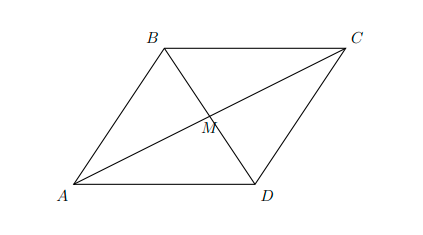
ABCD is a quadrilateral.
M is the midpoint of both diagonals $AC$ and $BD$.
Prove that triangle $ABM$ is congruent to triangle $CDM$.
This is a proof question involving midpoints and triangle congruence. The key is to identify equal sides and a pair of equal angles.
This is the style of question that exam boards like to use because it appears more difficult than it really is. It is easy to get distracted by the diagram and start chasing unnecessary angle properties or parallel lines. The key is to stay focused on exactly what you are being asked to prove.
Now try to complete the proof yourself before looking at the solution.
Solution
Since $M$ is the midpoint of $AC$:
$$AM = MC$$Since $M$ is the midpoint of $BD$:
$$BM = MD$$The angles $\angle AMB$ and $\angle CMD$ are vertically opposite angles:
$$\angle AMB = \angle CMD$$We now have two pairs of equal sides and the included angle equal:
- $AM = MC$
- $BM = MD$
- $\angle AMB = \angle CMD$
Therefore, by the SAS congruence rule:
$$\triangle ABM \cong \triangle CDM$$This completes the proof.
This result can be used to show that $ABCD$ is a parallelogram, since the diagonals bisect each other.
Ensure that the vertices correspond in congruence statements, There are four standard checks for congruency in triangles. These are SSS - all three sides are equal; SAS - two sides and the included angle are equal; ASA - two angles and the included side are equal (note: because of the angle sum of a triangle, AAS - two angles and a non-included side is just a special case of ASA) and RHS - a right angle, the hypotenuse and one side are equal.
Is there a topic you'd like to see featured? Request it on my Q & A page and I'll prioritize it for a future post.
Topics covered in this question
- Midpoints
- Triangle congruence (SAS)
- Vertically opposite angles
- Geometric proof